Rwanda Initiative Sustainable Environment and Agriculture[RISE]
Growing Sustainable Solutions for People and Planet.
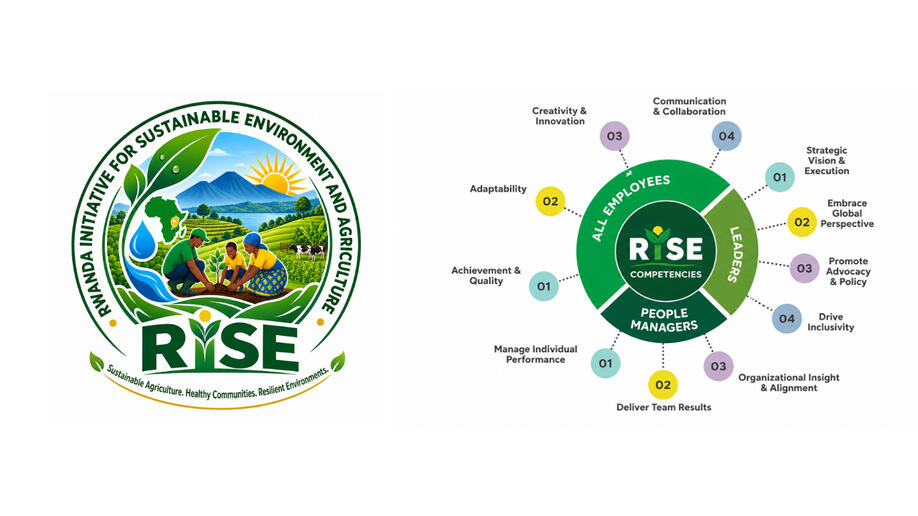
ABOUT US
Rwanda Initiative for Sustainable Environment and Agriculture (RISE) is a community-focused development organisation committed to advancing sustainable agriculture, environmental conservation, food and nutrition security, community health, climate resilience and inclusive socio-economic development.RISE works with communities, farmers, government institutions, development partners, civil society, research institutions, private-sector actors and other stakeholders to develop and promote practical solutions that improve livelihoods while protecting the environment and strengthening the resilience of people and ecosystems.Our approach recognises that agriculture, environment, health and human wellbeing are interconnected. Sustainable development therefore requires solutions that enable communities to increase agricultural productivity and incomes without degrading the natural resources on which present and future generations depend.RISE combines community action, research, knowledge sharing, capacity development, partnership building and policy advocacy to promote evidence-based and environmentally responsible development.Our work is particularly focused on communities and groups that are vulnerable to poverty, food insecurity, environmental degradation and the effects of climate change.
________________________________________
OUR VISIONVisionA food-secure, healthy and resilient Rwanda and Africa where communities thrive in harmony with nature, sustainable agriculture and responsible environmental resource management eradicate hunger, malnutrition and poverty and enhance the wellbeing of people and the planet.Our Vision ExplainedRISE envisions communities where:1] Every family has access to sufficient, safe and nutritious food;2] Farmers can sustainably increase productivity, incomes and resilience;3] Land, soil, water, forests and biodiversity are protected and responsibly managed;4] Communities are resilient to climate change and environmental shocks;5] Sustainable agricultural systems contribute to healthy people and healthy ecosystems;6] Research, innovation and indigenous knowledge inform development solutions;7] Communities participate meaningfully in decisions affecting their lives and natural resources; and8] Government, civil society, communities, researchers and the private sector work together for sustainable development.________________________________________
OUR MISSIONMissionTo advance sustainable development in Rwanda and across Africa by increasing agricultural productivity through environmentally responsible practices, strengthening food and nutrition security, protecting natural resources, and promoting the health, resilience and wellbeing of communities.How We Deliver Our MissionRISE pursues its mission through community-based programmes, research, capacity development, partnerships, knowledge sharing and policy advocacy that:a] Promote sustainable and appropriate land management practices;b] Advance environmentally friendly, climate-smart and regenerative agricultural practices;c] Promote soil conservation, restoration and sustainable soil fertility management;d] Encourage biodiversity-friendly farming systems and the protection of ecosystems;e] Strengthen food security, nutrition and community wellbeing;f] Promote sustainable management and responsible use of environmental and natural resources;g] Support communities to adapt to climate change and build resilience to environmental and socio-economic shocks;h] Conduct and promote research that strengthens agriculture, environment, health and community development programmes;i] Generate, document and share evidence, knowledge, innovations and good practices for sustainable development;j] Advocate for sound, inclusive and environmentally responsible policies, laws and institutional practices;k] Strengthen the capacity of communities, farmers, institutions and development actors;l] Build strategic local, national, regional and international partnerships for knowledge exchange, resource mobilisation and institutional strengthening; andm] Promote learning, collaboration and knowledge-sharing among communities, researchers, policymakers, development practitioners and other stakeholders.
________________________________________
OUR CORE VALUESRISE is guided by values that shape how we work, how we relate to communities and partners, and how we use the resources entrusted to us.1] PARTNERSHIPWe achieve more together.We believe sustainable development requires collective action. We build meaningful partnerships with communities, government, civil society, academia, research institutions, the private sector, development partners and other stakeholders to achieve greater impact.2] ADVOCACYWe speak for sustainable and equitable change.We promote evidence-based policies, laws and practices that advance environmental protection, sustainable agriculture, food security, health, social wellbeing and inclusive economic development.3] COMMUNITY OWNERSHIPDevelopment works best when communities lead.RISE is a stakeholder-driven organisation. We listen to communities, respect their knowledge and priorities, and promote meaningful participation in programme design, implementation, monitoring and learning.We believe communities should not simply be beneficiaries of development—they should be partners, decision-makers and owners of sustainable solutions.4] ACCOUNTABILITY — ONE RISEWe are One RISE, and we take responsibility for our actions.We are accountable to the communities we serve, our members, partners, donors, staff and other stakeholders. We use resources responsibly, communicate honestly and take responsibility for both our successes and our shortcomings.5] GROWTH AND LEARNINGOur organisation grows when our people grow.We continuously invest in people, knowledge, innovation and institutional development. We learn from experience, seek constructive feedback and create opportunities for our staff, volunteers, partners and communities to develop their capabilities.6] DIVERSITY AND INCLUSIONOur differences make us stronger.We value diversity in perspectives, experiences, knowledge, abilities and backgrounds. We listen to and respect one another and seek to ensure that women, men, young people, vulnerable groups and other stakeholders have meaningful opportunities to participate.7] HUMILITY AND CONTINUOUS IMPROVEMENTWe learn from our mistakes and improve together.We acknowledge that development is a learning process. We encourage openness, reflection and constructive criticism, address mistakes responsibly and use lessons learned to improve our programmes, systems and relationships.8] RESULTS AND IMPACTWe exist to create meaningful results.We focus on measurable and sustainable outcomes rather than activities alone. We use evidence, monitoring, evaluation and learning to understand what works, improve our interventions and demonstrate the difference we make.9] COMMUNICATION AND KNOWLEDGE SHARINGKnowledge should be accessible, useful and shared.We promote transparent, inclusive and barrier-free access to research, information, education and development knowledge. We encourage both vertical and horizontal communication and facilitate learning among communities, practitioners, researchers and policymakers.10] COLLABORATIONWe build relationships that create lasting solutions.We collaborate with individuals, communities, enterprises, institutions, associations, councils, agencies, federations, governments and other sustainable-development actors.11] RESOURCE STEWARDSHIPWe mobilise and use resources responsibly.We recognise that financial, human, natural and institutional resources are entrusted to us for a purpose. We pursue responsible resource mobilisation, sound financial management, efficiency, transparency and value for money.12] OPERATIONAL EXCELLENCEWe turn good intentions into effective action.We remain focused on the needs of our target communities, maintain strong organisational systems, develop our people, manage resources prudently and use evidence and policy positions to guide our strategies and decisions.________________________________________
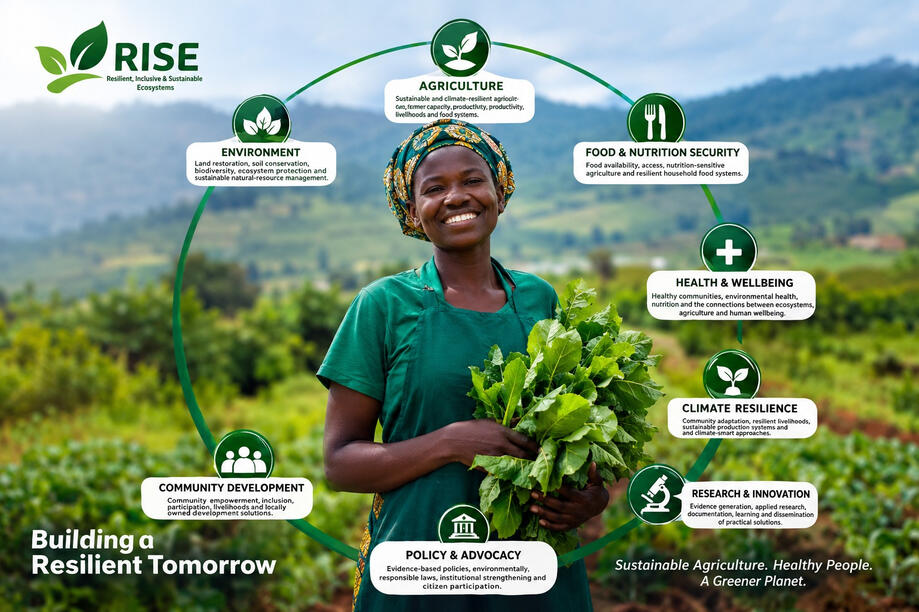
OUR STRATEGIC POSITIONINGRISE operates at the intersection of:AGRICULTURESustainable and climate-resilient agriculture, farmer capacity, productivity, livelihoods and food systems.ENVIRONMENTLand restoration, soil conservation, biodiversity, ecosystem protection and sustainable natural-resource management.FOOD & NUTRITION SECURITYFood availability, access, nutrition-sensitive agriculture and resilient household food systems.HEALTH & WELLBEINGHealthy communities, environmental health, nutrition and the connections between ecosystems, agriculture and human wellbeing.CLIMATE RESILIENCECommunity adaptation, resilient livelihoods, sustainable production systems and climate-smart approaches.RESEARCH & INNOVATIONEvidence generation, applied research, documentation, learning and dissemination of practical solutions.POLICY & ADVOCACYEvidence-based policies, environmentally responsible laws, institutional strengthening and citizen participation.COMMUNITY DEVELOPMENTCommunity empowerment, inclusion, participation, livelihoods and locally owned development solutions.________________________________________
OUR PROGRAMME AREASRISE can organise its programmes around six strategic pillars.Pillar 1 — Sustainable Agriculture & Food SystemsRISE promotes agricultural systems that increase productivity while protecting soil, water, biodiversity and ecosystems.Key areas include:A] Sustainable farming;
B] Climate-smart agriculture;
C] Regenerative agriculture;
D] Agroecology;
E] Soil fertility management;
F] Sustainable crop production;
G] Integrated farming systems;
H] Sustainable livestock systems;
I] Farmer capacity development;
J] Post-harvest management;
K] Food systems resilience; and
J] Sustainable agricultural value chains.
Pillar 2 — Environment, Land & BiodiversityRISE works with communities to protect and restore natural resources and ecosystems.Key areas include:1] Land degradation prevention;
2] Soil and water conservation;
3] Landscape restoration;
4] Biodiversity conservation;
5] Ecosystem protection;
6] Sustainable natural-resource management;
7] Agroforestry;
8] Watershed protection;
9] Environmental education; and
10] Community environmental stewardship.Pillar 3 — Climate Resilience & Sustainable LivelihoodsRISE supports communities to anticipate, withstand and recover from environmental and socio-economic shocks.Key areas include:A] Climate adaptation;
B] Climate-resilient agriculture;
C] Community resilience;
D] Sustainable livelihoods;
E] Nature-based solutions;
F] Disaster-risk reduction;
G] Green enterprises;
H] Sustainable resource use; and
I] Community-led climate action.
Pillar 4 — Food, Nutrition, Health & WellbeingRISE recognises that sustainable agriculture should ultimately contribute to healthier people and communities.Key areas include:1] Household food security;
2] Nutrition-sensitive agriculture;
3] Nutrition education;
4] Healthy food systems;
5] Environmental health;
6] Community health promotion;
7] Prevention of nutrition-related vulnerabilities; and
8] Integrated agriculture-health-environment approaches.Pillar 5 — Research, Innovation, Knowledge & LearningRISE generates and shares knowledge that can improve development practice and policy.Key areas include:A] Applied research;
B] Community-based research;
C] Agricultural research;
D] Environmental research;
E] Health-related research;
F] Baseline and needs assessments;
G] Monitoring, evaluation and learning;
H] Documentation of indigenous and local knowledge;
I] Innovation and piloting;
Knowledge products; and
J] Learning and experience-sharing platforms.
Pillar 6 — Policy, Advocacy & PartnershipsRISE promotes an enabling environment for sustainable development.Key areas include:1] Policy research and analysis;
2] Environmental policy advocacy;
3] Sustainable agriculture policy;
4] Community participation in policy processes;
5] Institutional strengthening;
6] Stakeholder engagement;
7] Partnership development;
8] Resource mobilisation;
9] Public awareness; and
10] Regional and international cooperation.________________________________________
OUR APPROACHRISE follows a community-centred, evidence-based and partnership-driven approach.Community FirstWe begin with community needs, knowledge, priorities and aspirations.Evidence DrivenWe use research, data, local knowledge and lessons learned to inform decisions.Environmentally ResponsibleWe seek solutions that improve livelihoods without compromising ecosystems or future generations.Locally OwnedWe strengthen local capacities and promote community ownership rather than dependency.Partnership BasedWe bring together complementary expertise, resources and networks.InclusiveWe promote meaningful participation of women, men, youth, vulnerable households, farmers and other relevant stakeholders.Learning OrientedWe test, learn, adapt, document and scale approaches that demonstrate results.Results FocusedWe measure our contribution to meaningful and sustainable changes in people's lives and the environment.________________________________________
OUR TARGET GROUPSRISE primarily works with:1] Smallholder farmers;
2] Rural households;
3] Women and women-led households;
4] Youth;
5] Vulnerable and economically disadvantaged communities;
6] Farmer organisations and cooperatives;
7] Community-based organisations;
8] Environmental groups;
9] Local institutions;
10] Researchers and students;
11] Small and medium enterprises;
12] Agricultural value-chain actors; and
13] Other communities and stakeholders affected by food insecurity, environmental degradation and climate vulnerability.________________________________________
OUR PARTNERSRISE believes that no single organisation can solve complex development challenges alone.We therefore seek strategic partnerships with:1] Government ministries and agencies;
2] Local government authorities;
3] Development partners;
4] UN agencies;
5] International NGOs;
6] National civil-society organisations;
7] Universities and research institutions;
8] Farmer organisations and cooperatives;
9] Private-sector companies;
10] Foundations and philanthropic organisations;
11] Environmental organisations;
12] Community-based organisations;
13] Professional associations;
14] Media organisations; and
15] Regional and international networks.________________________________________
RESEARCH, EVIDENCE AND LEARNINGRISE considers research and learning essential to effective development.We undertake and support research that generates practical evidence for improving:Agriculture → Environment → Food & Nutrition → Health → Livelihoods → PolicyOur research approach seeks to bridge the gap between knowledge and action by translating research findings into practical interventions, policy recommendations, community solutions and knowledge products.RISE promotes:1] Participatory research;
2] Action research;
3] Applied agricultural research;
4] Environmental research;
5] Community knowledge documentation;
6] Policy research;
7] Programme learning;
8] Monitoring and evaluation;
9] Knowledge dissemination; and
10] Research-practice partnerships.
____________________________ADVOCACY AND POLICY INFLUENCERISE seeks to contribute to policies and institutional practices that enable sustainable agriculture, environmental conservation and improved community wellbeing.Our advocacy is:1] Evidence based;
2] Constructive;
3] Non-partisan;
4] Community informed;
5] Solutions oriented; and
6] Focused on measurable public benefit.We engage relevant stakeholders through *research, policy dialogue, community mobilisation, public education, stakeholder consultations, knowledge products and strategic partnerships.
____________________________OUR THEORY OF CHANGE
IFcommunities have access to knowledge, appropriate technologies, research, resources, partnerships and enabling policies;AND IFfarmers and other stakeholders adopt sustainable agricultural, land-management and environmental practices;AND IFcommunities participate meaningfully in decisions affecting their livelihoods and natural resources;THENagricultural productivity, food and nutrition security, environmental health, livelihoods and community resilience will improve;ULTIMATELYcontributing to healthier people, resilient communities, protected ecosystems and sustainable development in Rwanda and across Africa.
____________________________EXPECTED DEVELOPMENT IMPACTRISE seeks to contribute to five long-term outcomes:1. More Productive and Sustainable AgricultureFarmers adopt practices that increase productivity while maintaining the health of soils, water systems and ecosystems.2. Healthier and More Resilient CommunitiesHouseholds experience improved food security, nutrition, livelihoods and wellbeing.3. Protected and Restored EcosystemsCommunities become effective stewards of land, soil, water, forests and biodiversity.4. Stronger Evidence and InstitutionsResearch, learning, capacity development and partnerships strengthen sustainable-development practice.5. Better Policies and PracticesEvidence and community voices contribute to stronger policies, laws and institutional approaches for sustainable development.
____________________________OUR COMMITMENT TO THE SDGsRISE's work contributes particularly to the following Sustainable Development Goals:SDG 1 — No Poverty
SDG 2 — Zero Hunger
SDG 3 — Good Health and Well-being
SDG 5 — Gender Equality
SDG 6 — Clean Water and Sanitation
SDG 8 — Decent Work and Economic Growth
SDG 12 — Responsible Consumption and Production
SDG 13 — Climate Action
SDG 15 — Life on Land
SDG 17 — Partnerships for the Goals
________________________________________WHAT MAKES RISE DIFFERENT?RISE brings together areas that are often addressed separately.Our integrated model is:Sustainable Agriculture
↓
Healthy Soils & Ecosystems
↓
Food & Nutrition Security
↓
Healthy Communities
↓
Resilient Livelihoods
↓
Environmental Sustainability
↓
Sustainable DevelopmentWe believe that food security cannot be separated from environmental security, and human health cannot be separated from the health of the ecosystems on which communities depend.This integrated perspective is central to the RISE identity.
____________________________RISE'S ORGANISATIONAL PROMISETo CommunitiesWe listen, respect, empower and work alongside communities.To PartnersWe build transparent, mutually beneficial and results-oriented relationships.To DonorsWe pursue responsible stewardship, measurable results, transparency and value for money.To GovernmentWe contribute evidence, community perspectives, innovation and constructive policy engagement.To Staff and VolunteersWe promote learning, professional growth, inclusion, accountability and teamwork.To the EnvironmentWe promote responsible use, restoration and protection of natural resources for present and future generations.________________________________________RESOURCE MOBILISATIONRISE recognises that ambitious development outcomes require sustainable resources.We therefore pursue responsible resource mobilisation through:1] Institutional and programme grants;
2] Foundations and philanthropic funding;
3] Government partnerships;
4] Research grants;
5] Development-partner funding;
6] Corporate partnerships;
7] Community and private-sector partnerships;
8] Technical assistance opportunities;
9] Social-impact initiatives;
10] Membership and partnership contributions; and
11] Other lawful and mission-aligned sources.All resource mobilisation activities are guided by RISE's mission, values, ethical standards and commitment to accountability.
____________________________ORGANISATIONAL PRINCIPLESRISE is committed to:Integrity — We do what is right.Accountability — We take responsibility for our decisions and results.Transparency — We communicate openly and manage resources responsibly.Participation — We involve stakeholders in decisions that affect them.Equity and Inclusion — We seek to ensure that vulnerable and underrepresented groups are not left behind.Sustainability — We pursue solutions that remain beneficial beyond the life of individual projects.Evidence — We value research, data, local knowledge and learning.Innovation — We encourage practical and locally appropriate solutions.Do No Harm — We consider social, environmental and unintended consequences in our interventions.Sustainable Agriculture. Healthy Communities. Resilient Environments.________________________________________
RISE'S OVERVIEWRISE believes that sustainable development begins with healthy land, productive agriculture, empowered communities and responsible stewardship of natural resources.Our ambition is not simply to increase agricultural production. It is to help create food-secure families, healthy communities, resilient livelihoods and protected ecosystems.Through partnerships, research, community action, innovation and advocacy, RISE seeks to contribute to a future where agriculture sustains people, environmental resources are responsibly managed, communities are empowered to shape their own development, and the wellbeing of people and planet advances together.RISE — Growing Sustainable Solutions for People and Planet.RISE connects sustainable agriculture, environmental conservation, food and nutrition security, health, climate resilience, research and policy advocacy to create healthier people, resilient communities and protected ecosystems.RISE as an integrated sustainable-development organisation with a distinctive connection between people, agriculture, environment and health.
____________________________ORGANISATIONAL PROFILE AT A GLANCEArea and RISE PositionFull Name Rwanda Initiative for Sustainable Environment and AgricultureAcronym
RISEGeographic Focus Rwanda and AfricaPrimary Approach Community-based, evidence-driven and partnership-orientedCore Sectors
Agriculture, Environment, Food & Nutrition, Health, Climate
Resilience, Research and AdvocacyPrimary Beneficiaries Communities, farmers, households, women, youth and vulnerable groupsCore Methods Projects, research, capacity building, advocacy, partnerships and knowledge sharingVision Food-secure, healthy and resilient communities living in harmony with natureMission Advancing sustainable development through sustainable agriculture, environmental protection, food security, health and resilienceCorporate Tagline Sustainable Agriculture. Healthy Communities. Resilient Environments.
____________________________ENVIRONMENTAL HEALTH PROJECTS/ACTIVITIESEnvironmental Health Areas that DEMAND OUR INITIATIVES along with community engagement:1] Environmental Education and Public AwarenessWhat it involves: Teaching communities about clean water, waste disposal, and hygiene.It is important and easily implemented. It requires minimal specialized equipment, relying instead on workshops, school programs, and printed guides.Impact: Empowers people to change daily health habits.2] Community Cleanups and Waste ReductionWhat it involves:Organizing neighborhood cleanups, promoting recycling, and reducing single-use plastics.It is important and easily implemented: Volunteers drive the work, and supplies only require basic tools like gloves, bags, and rakes.Impact: Immediately improves local surroundings and reduces disease vectors like standing water or piled trash.3] Tree Planting and Urban GreeningWhat it involves: Planting trees in neighborhoods, schools, or parks to improve air quality and provide shade.It is important and easily implemented: Saplings are inexpensive, and local volunteers can easily handle planting events.Impact: Lowers local temperatures, filters air pollutants, and builds community spirit.4] Safe Water and Sanitation AdvocacyWhat it involves: Promoting safe drinking practices, such as boiling or filtering water, and building basic latrine awareness.It is important and easily implemented: Focuses on distributing educational messages and simple testing kits rather than engineering large water systems.Impact: Directly cuts down rates of waterborne illnesses in vulnerable areas.
____________________________OUR CONTACTSMAILING ADDRESS
Rwanda Initiative for sustainable Environment & Agriculture (RISE)
ePoBox 0040784613 - KigaliLOCATION
TABZ Plaza, Opposite University of Rwanda College of Medicine and Health Sciences, Kimironko RoadPHONES
Mobile PHONE/WHATSAPP
+250788486137
Office PHONE
(+250) 0722497722 [Main]
(+250) 0728552850 [Alternative]E-MAIL
[email protected]
[email protected]WEBSITE
https://sites.google.com/view/rwandainit4sustenvironandagrichttps://rwandainitiative4sustenvandagric.carrd.co/https://rise.org.rwHOURS: M-F 9am-5pm EA TIMESOCIALISE
FIND us on Google My Business | LinkedIn | Facebook | Twitter | Instagram |TikTok| YouTube
____________________________REFUGEE MULTI-SECTORAL PROGRAMSOur moto "Restoring Ecosystems, Building Resilience, Creating Green Futures." guides our operations.RISE does act not merely as a humanitarian actor, but as a long-term resilience and self-reliance organization supporting refugees and displaced populations through livelihoods, protection, climate action, education, and peacebuilding.
____________________________
FLAGSHIP INITIATIVERefugee Innovation and Resilience Centers (RIRC)We will establish centers inside or near refugee settlements that provide:1] Vocational training
2] ICT services
3] Business incubation
4] Counseling services
5] Library and learning opportunities
6] Women's empowerment programsThe centers would become RISE's signature intervention model.
____________________________
CROSS-CUTTING THEMES1] Gender equality
2] Disability inclusion
3] Child protection
4] Climate adaptation
5] Human rights
6] Digital transformation
7] Peacebuilding
8] Community participation
____________________________
EXPECTED FIVE-YEAR IMPACTa] 20,000+ refugees and displaced persons reached
b] 5,000 households economically empowered
c] 10,000 youth trained in skills development
d] 1 million trees planted
e] 500 small businesses established
f] Significant reduction in dependency on humanitarian assistance
h] Improved social cohesion between refugees and host communities
____________________________
ONE OF CURRENT PROJECTS TITLE by RISERefugee Climate Resilience and Green Livelihoods Project (RCRGLP)a] Project LocationRefugee camps and host communities in Rwandab] Project Executive SummaryRefugee settlements often experience significant environmental pressures due to increased demand for land, firewood, water, and agricultural production. Over time, this leads to deforestation, soil degradation, declining agricultural productivity, waste accumulation, and increased vulnerability to climate-related shocks.Many refugee households depend heavily on firewood for cooking, contributing to environmental degradation and exposing women and girls to protection risks associated with firewood collection. Limited access to climate-smart farming technologies also undermines household food security and resilience.The Refugee Climate Resilience and Green Livelihoods Project seeks to address these challenges through ecosystem restoration, climate-smart agriculture, renewable energy solutions, clean cooking technologies, and circular economy initiatives.c] Project Problem StatementRefugee-hosting areas face increasing environmental degradation caused by deforestation, fuelwood dependency, poor waste management, climate variability, and declining agricultural productivity.Women and children are especially affected through long distances traveled to collect firewood, food insecurity, and increased vulnerability to climate shocks.d] Overall GoalTo strengthen climate resilience, restore degraded ecosystems, improve food security, and promote sustainable environmental management among refugees and host communities.
____________________________MENTAL HEALTH OVERVIEWMENTAL HEALTH CRISIS_ GLOBALLYThe World Health Organization says that 1 in 8 people worldwide suffer from a mental health disorder; Lancet’s 2026 Global Burden of Disease Study agrees, arguing that the affected population approaches 1.2 billion.
And data from the Institute for Health Metrics and Evaluation at Washington University in the United States show a 95% increase in mental health cases between 1990 and 2023.
The impact is even more profound among youth: roughly 293 million children and young adults under 25 live with a mental health condition.AGRICULTURE, ENVIRONMENT AND HEALTH NEXUSRISE operates at the intersection of environmental health, agriculture, and environmental sustainability, its mental health program addresses the psychological impacts of climate change, agricultural stress, environmental degradation, livelihood insecurity, and community wellbeing.MENTAL HEALTH PROGRAMRISE Mental Health and Psychosocial Wellbeing Program (MHPWP)Program Title "Resilient Minds, Resilient Communities Initiative"1. Program GoalTo improve mental health, psychosocial wellbeing, and resilience among vulnerable communities affected by environmental, agricultural, and public health challenges.2. Strategic ObjectivesObjective 1:
Increase awareness and understanding of mental health within agricultural and environmentally vulnerable communities.Objective 2:
Strengthen community resilience against climate-related stress, disasters, and livelihood shocks.Objective 3:
Integrate mental health services into environmental health and agricultural development programs.Objective 4:
Support vulnerable populations, including farmers, women, youth, refugees, persons with disabilities, and environmental workers.Objective 5:
Promote workplace mental health and wellbeing among RISE staff and partners.3. Program ComponentsPillar 1: Community Mental Health AwarenessPillar 2: Climate Change and Mental HealthPillar 3: Farmer Wellbeing InitiativePillar 4: Youth Mental Health and Green FuturesPillar 5: Women's Mental Health and EmpowermentPillar 6: Nature-Based Healing and Eco-TherapyPillar 7: Community Counselling and Referral ServicesPillar 8: Workplace Mental Health Program____________________________
Cross-Cutting ThemesGender Equality
Ensure all interventions are gender responsive.Disability Inclusion
Provide accessible mental health services.Environmental Sustainability
Utilize green and nature-based approaches.Digital Innovation
Mobile counselling and tele-mental health services.Community Ownership
Engage local leaders and community groups.
____________________________
Key Beneficiaries
• Smallholder farmers
• Youth
• Women and girls
• Persons with disabilities
• Climate-affected communities
• Community health workers
• Refugees and displaced persons
• Environmental workers
• RISE staff
____________________________
Expected Five-Year ResultsTarget:100,000
Indicator:People reached with mental health awarenessTarget:15,000
Indicator:Individuals receiving psychosocial supportTarget:10,000
Indicator:Farmers trained in resilience and wellbeingTarget:20,000
Indicator:Youth participating in mental health programsTarget:200
Indicator:Community support groups establishedTarget:500
Indicator:Community counsellors trainedTarget:100
Indicator: Schools with wellness clubsTarget:50
Indicator: Nature-based healing sites established
___________________________
Flagship Project
RISE Green Minds Initiative
A flagship integrated program combining:
• Climate resilience
• Farmer wellbeing
• Community mental health
• Youth empowerment
• Environmental restoration
• Nature-based healing